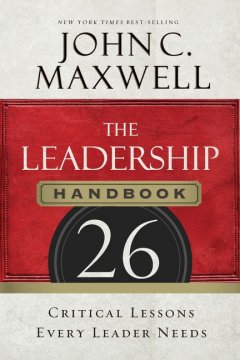
I suspect that I am like many others who, upon hearing the mention of his name, would immediately associate John Maxwell with the topic of “leadership.” The classic and most well-known of his books would (I assume) be “The 21 Irrefutable Laws of Leadership.” But simply type his name into amazon’s search function and you’ll see that that is not anywhere close to the last book that he wrote on the subject. Maxwell’s output on the subject is voluminous and extensive, so I wasn’t exactly sure what to expect with this book, “The Leadership Handbook.” What would he have to say on the subject that he hadn’t said some other way in some other book? What fresh insights are there to be gleaned here?
Perhaps it was my admittedly mixed expectations for the book, but the further I got into the book the more that I found myself enjoying, learning from, and appreciating it. Maxwell himself sums up what differentiates this book from many of his previous ones on page 247, where he says:
You’ll notice that there has been a significant shift in my thinking…Now, instead of focusing on who I am to become, my focus is on other people…I want to add value to leaders who will multiply value to others.
John Maxwell has gone from wanting to be a great leader himself to wanting to teach others how to be great leaders to wanting to teach others how to teach others how to be great leaders. Thus he suggests two ways of reading the book. The first is to read a chapter a week, spending time to meditate on the lessons and application questions in each chapter. The second is to take 52 weeks to go through the book, spending one week to go over a chapter yourself and then taking the next week to teach that lesson to whoever it is that you are currently mentoring. Each chapter has a “Mentorship Moment” at the end to assist in this process.
In “The Leadership Handbook,” Maxwell seems to be catching sight of the same kind of leadership and discipleship that both Jesus (“Go and make disciples…teaching them to obey everything I’ve commanded you” […by inference including making disciples]) and Paul (“and what you have heard from me in the presence of many witnesses entrust to faithful men who will be able to teach others also”) modeled and taught.
Finally, in addition to teaching leadership from his successes, Maxwell teaches from his failures. His honesty about the role that failure has in the growth of a leader is admirable and much needed.
So what’s the verdict? I see this book functioning exactly as it’s billed: as a handbook to slowly work through, refer to, and learn from as leaders seek to grow personally and pass their lessons on to the leaders they are training up themselves. I know that I personally have several immediate applications from it and also that I’ll be returning to it often as a refresher and reminder.
Rating: 4 stars out of 5
Disclaimer: BookLook Bloggers has provided me with a complimentary copy of this book in exchange for an impartial review.



Add your voice to the discussion